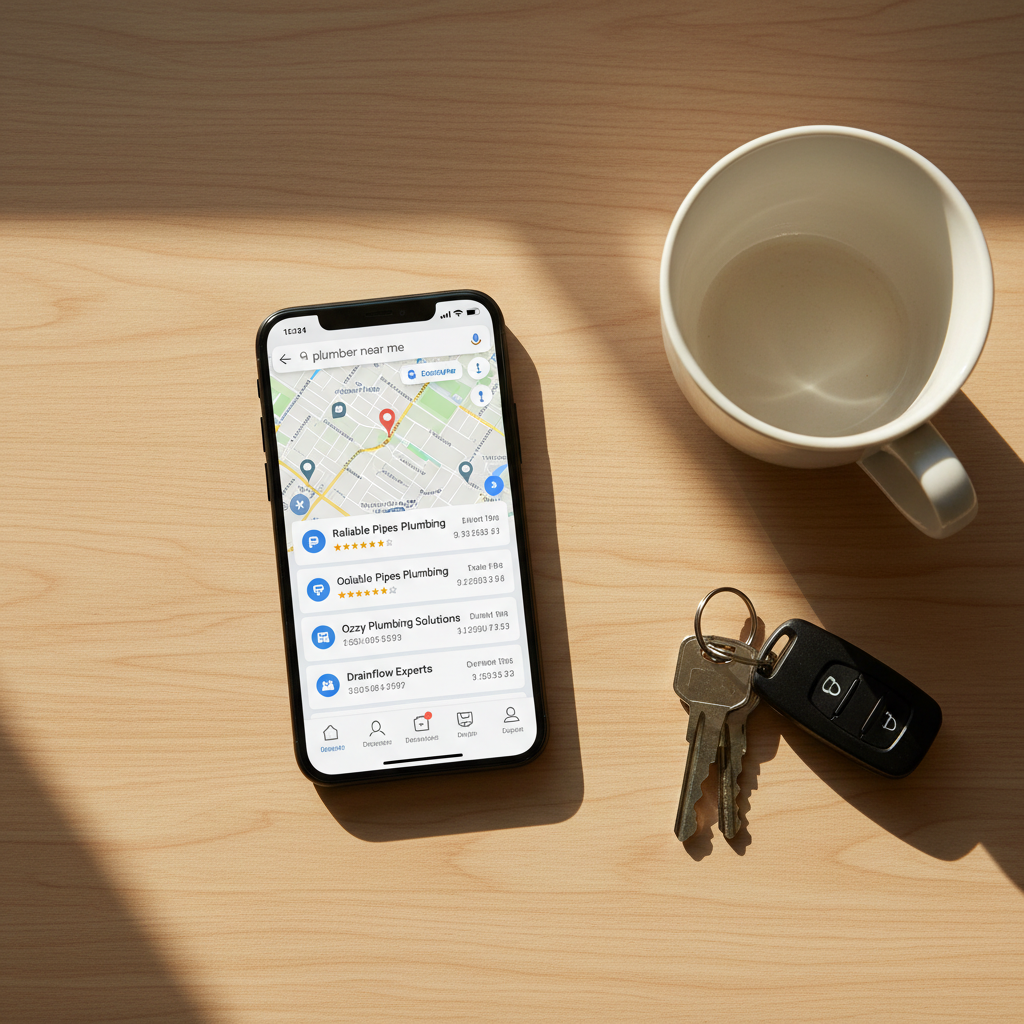
What "Local SEO" Actually Means
When we say local SEO, we're not talking about "city-wide" rankings. We're not talking about appearing for "plumber Gold Coast" or "electrician Melbourne." That's broad — and broad doesn't book jobs.
We're talking about suburb-by-suburb visibility — where real service enquiries actually come from. The specific, high-intent searches that happen when someone's hot water system just failed or their power is out and they need someone right now.
Customers don't search like marketers think they do. They search like this:
- "Plumber Pimpama"
- "Electrician Upper Coomera"
- "Emergency repairs Ormeau"
- "Removalist near Hope Island"
That's suburb-based intent. And it's the highest-value traffic a service business can get — because the person searching has already committed to a location. They're not comparing cities. They're choosing a provider in their suburb.
Think about your own behaviour. When your dishwasher floods at 7pm and you need an emergency plumber, you don't search for "plumber." You search for "emergency plumber [your suburb]." You want someone who's close, who can come now, and who services your specific area. That's exactly how your customers search — and the business that shows up for those searches wins the job without needing to do anything else to compete.

46% of all Google searches have local intent. Of those, searches that include a specific suburb or postcode convert to enquiries at nearly double the rate of city-wide searches.

Suburb Searches = Ready-to-Book Customers
Suburb searches aren't research searches. They're action searches.
When someone adds a suburb name to a service query, it signals a very specific set of buying signals:
- They know what they need
- They want someone local — not someone who "covers the region"
- They want it soon, often today
- They're choosing from whoever appears first on that page
If your business doesn't appear for each suburb you service, you're invisible to that customer — even if you're only 5 minutes away. There's no reward for proximity if you're not on the first page.
| Search Type | Intent Level | Typical Conversion Rate |
|---|---|---|
| "plumber" | Low — browsing | 1–3% |
| "plumber Gold Coast" | Medium — researching | 5–8% |
| **"plumber Pimpama"** | **High — ready to book** | **15–25%** |
| "emergency plumber Pimpama" | Urgent — booking now | 30%+ |
The more specific the search, the more committed the customer. Suburb-level searches sit at the most valuable end of the spectrum.
Key Takeaway
Suburb-based searches carry the highest purchase intent of any local query type — customers who include a specific suburb in their search are significantly more likely to book than those searching at a city or regional level.
Why "One Website Page" Doesn't Work Anymore
A single homepage saying "We service the Gold Coast" is no longer sufficient. It worked five years ago. It doesn't work now.
Google has become exceptionally sophisticated at understanding relevance at a hyper-local level. When someone searches "electrician Varsity Lakes," Google isn't looking for who services the Gold Coast generally — it's looking for the most relevant result for Varsity Lakes specifically.
That means Google needs clarity about three things:
- What service do you provide?
- In which suburb?
- How relevant and trusted are you for that exact location?

That's why suburb-based SEO requires a fundamentally different approach:
- Individual suburb pages — one dedicated page per suburb you service
- Unique, location-specific content — not copy-paste with the suburb name swapped out
- Clear service + suburb pairing — "Emergency Plumbing in Pimpama" not "Plumbing Services"
- Local signals Google can trust — citations, reviews mentioning the suburb, schema markup
- Properly structured Google Business Profile — listing the right service areas with consistent NAP (name, address, phone) data across the web
The content on each suburb page also matters. Google's algorithms are sophisticated enough to identify thin, templated content where only the suburb name changes. Effective suburb pages need genuinely localised information — references to local landmarks, typical service scenarios in that area, and testimonials from customers in that suburb where possible.
Without this architecture, Google ranks competitors who are doing it properly. They haven't necessarily got better reviews or more experience — they've just built the right structure.

Your Competitors Are Winning Suburb by Suburb
This is how smart service businesses dominate their local market — not with a bigger advertising budget, but with better strategy:
- One service
- One suburb
- One focused page
They're not trying to rank everywhere with one page. They're owning suburbs one at a time — methodically building visibility across their entire service area.
The results compound. One suburb page starts ranking. The authority flows to nearby pages. Within 3–6 months, a business can have 20, 30, even 50 suburb pages all generating consistent inbound enquiries.
| Business Approach | Monthly Leads | Cost Per Lead | Lead Quality |
|---|---|---|---|
| Single homepage, city-level | 5–10 | High (relies on ads) | Mixed |
| Suburb SEO pages (10+ suburbs) | 30–60 | Low (organic) | High |
| Suburb SEO + AI call handling | 30–60 | Low (organic) | High + zero missed |
While other businesses rely on paid ads or word-of-mouth alone, businesses with proper suburb SEO get consistent inbound calls — at lower cost per lead and with higher conversion rates — because they're showing up exactly where customers are looking.
76%
of people who search for a local service on their smartphone visit or contact a business within 24 hours
Local SEO Without Call Handling Is Still a Leak
Here's the hard truth that most SEO conversations ignore.
Even if you rank perfectly for every suburb search in your area — page one, top three, all the right keywords — if the calls you generate aren't being answered, you're still losing the jobs to a competitor who is answering.
This is the most frustrating outcome in local business: investing in visibility, then leaking the leads because the systems to capture them aren't in place.
The most common leaks:
- Calls going unanswered during jobs
- After-hours calls hitting voicemail
- Enquiry forms sitting unanswered for hours
- Leads not being followed up quickly enough
That's why suburb-based SEO must be paired with:
- Missed-call capture — an AI that instantly texts back anyone who doesn't get through
- AI call answering — a voice assistant that handles calls when you're on the tools
- Instant lead handling — automated follow-up within seconds of an enquiry
Traffic without response is wasted opportunity — and wasted money.
Suburb SEO Is Revenue Protection
This isn't about chasing more traffic for its own sake. It's about being found first, locally, and answered instantly — the complete loop that turns a search into a booked job.
For service businesses, the formula is straightforward:
- Suburb-based SEO = visibility — you appear when the right customer searches
- AI call handling = conversion — every lead is captured and responded to
- Automated systems = consistency — results don't depend on whether you have a good week
Together, they stop revenue from leaking to competitors down the road. Separately, each one has gaps.

Key Takeaway
Suburb SEO and AI call handling aren't separate tools — they're two halves of the same revenue protection system. One gets the customer to call. The other makes sure the call is never wasted.
The Final Reality Check
Your customers aren't searching for your business name. They haven't heard of you yet. They're searching for a service + their suburb — and whoever appears first, with a professional presence and an immediate response, gets the job.
If you're not appearing for those searches, someone else is getting paid.
The businesses winning right now aren't spending more on ads. They've built the right organic infrastructure — suburb by suburb — and paired it with systems that capture every enquiry. That combination creates a compounding advantage that gets stronger over time.
For service businesses in competitive markets like South East Queensland, Sydney, or Melbourne, the suburb SEO window is still open — but it won't be forever. Every week, more competitors are building these pages and capturing more of the available search traffic. The businesses that move now will be entrenched by the time late movers catch up.
It's not about being perfect. It's about showing up where your customers are looking — and having the systems in place so that when they do find you, the call is always answered.
Want suburb-by-suburb visibility that actually drives calls to your business? Talk to the Leadbots team — we build location-specific pages paired with AI call handling so you never miss a local lead again.
Ready to take action?
Need Help Implementing This?
Our team can build a custom solution tailored to your business. Book a free strategy call to get started.
Call 0447 091 555